Trailer manufacturers face constant pressure to produce stronger, safer products while maintaining tight production schedules and controlling labor costs. As demand for trailers continues to grow across transportation, agriculture, and construction industries, fabricators are looking for ways to streamline operations without sacrificing quality. One area where significant gains can be achieved is welding. By implementing the Uni-Bug III welding automation system, manufacturers can reduce production time, improve consistency, and create more reliable welds across critical trailer components.
Customer Overview: Fabricating Beams and Chassis for Trailers
Trailer production depends heavily on the fabrication of beams, frames, and chassis assemblies that must withstand substantial loads and harsh operating conditions. These components are often constructed from heavy-gauge materials and require precise welding to maintain structural integrity.
In many facilities, multiple welding stations are responsible for joining long sections of steel, while maintaining strict dimensional tolerances. Since every weld joint contributes to the overall performance of the finished trailer, maintaining consistent weld quality is essential. Manufacturers commonly rely on various welding processes to complete these assemblies, but manual methods can introduce inconsistencies that affect both appearance and performance.
For companies involved in trailer manufacturing, even small improvements in efficiency can generate significant savings over hundreds or thousands of units produced each year.
The Challenge: Inconsistencies in Manual Welding Operations
Manual welding operations depend heavily on operator skill, concentration, and physical endurance. Even experienced welders can struggle to maintain consistent travel speed, torch positioning, and welding parameters during long production shifts.
Variations in speed or positioning can alter heat input, affect penetration, and create inconsistencies throughout the weld. As a result, manufacturers may encounter issues such as uneven bead profiles, excessive spatter, undercutting, or incomplete fusion.
These challenges become even more pronounced when fabricating long seams on trailer beams and chassis components. Maintaining consistent wire feeding and travel speed over extended distances requires constant attention from welding operators. Fatigue, distractions, and repetitive movements can all contribute to quality variations that impact production efficiency.
How Frequent Starts and Stops Lead to Weld Defects
One of the most common problems associated with manual welding is the need for frequent starts and stops. Every time an operator pauses and restarts an arc welding process, the potential for defects increases.
Starting and stopping can create inconsistent bead transitions, overlap issues, and changes in penetration. These interruptions may also influence filler metal deposition rates and affect overall weld quality. When multiple welders perform the same task using slightly different techniques, inconsistencies can become even more noticeable.
In trailer fabrication, where long seams are common, interruptions can lead to visible imperfections and additional inspection failures. Repeated starts and stops also make it more difficult to achieve high quality welds that meet customer specifications and industry standards.
Manufacturers seeking an improved weld often discover that mechanized systems help eliminate many of these variables by maintaining continuous, controlled movement throughout the welding cycle.
The Hidden Costs of Rework, Labor Demands, and Operator Strain
The direct cost of repairing defective welds is only one part of the problem. Rework consumes valuable labor hours, delays production schedules, and increases material consumption.
Additional grinding, cleaning, and repair work can significantly increase manufacturing costs while reducing overall throughput. In facilities with high production volumes, these inefficiencies can quickly add up.
Physical strain is another major concern. Manual welding requires operators to maintain awkward positions for extended periods while managing welding torches, cables, and a wire feeder. Over time, repetitive tasks can contribute to fatigue and increase the likelihood of errors.
Beyond productivity concerns, manufacturers are increasingly focused on improving safety within fabrication environments. Reducing repetitive motion and minimizing operator exposure to hazardous working positions can contribute to a safer workplace while supporting long-term workforce retention.
The Solution: Implementing the Uni-Bug III Welding Automation System
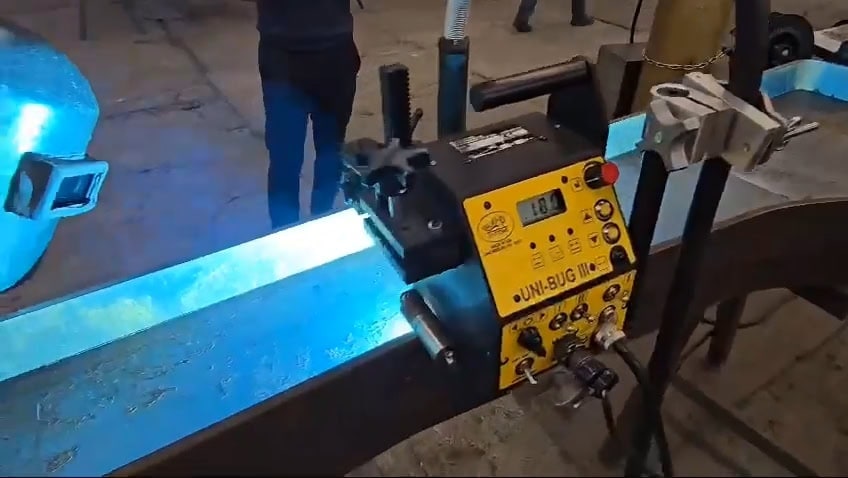
To address these challenges, the manufacturer implemented the Uni-Bug III system from Bug O Systems. Designed specifically for welding mechanization applications, the system automates torch travel while allowing operators to maintain control of critical welding functions.
The Uni-Bug III provides consistent movement along the workpiece, helping maintain stable welding parameters throughout the process. By eliminating many variables associated with manual welding, the system creates precise welds with greater repeatability.
The equipment integrates seamlessly with existing welding solutions and can support various welding processes commonly used in trailer production. With controlled travel speeds, consistent wire feeding, and stable torch positioning, the system delivers a more predictable welding environment.
Because welding requires consistency to achieve optimal results, mechanized equipment provides a practical way to standardize production while reducing dependence on individual operator technique.
Achieving a 30% Reduction in Welding Time through Mechanization
Following implementation, the manufacturer experienced approximately a 30% reduction in welding time. This improvement was achieved through continuous travel, reduced setup interruptions, and more efficient production workflows.
By automating torch movement, operators could focus on monitoring the process rather than manually controlling every aspect of the weld. The reduction in starts and stops helped maintain a steady welding pace while increasing productivity across multiple fabrication lines.
The improved efficiency also allowed the company to complete more units within the same production schedule. For facilities working with structural steel components and large trailer assemblies, even modest reductions in cycle times can generate substantial annual savings.
As labor shortages continue to affect the manufacturing sector, mechanization offers a practical strategy for increasing output without significantly expanding workforce requirements.
Near-Elimination of Defects and Faster Skill Development
In addition to faster production, the company achieved a near-elimination of weld defects. Consistent travel speed, controlled heat input, and stable torch positioning contributed to an overall improvement in weld quality.
The system also simplified training for newer employees. Since many aspects of the welding operation were standardized, less-experienced operators could produce acceptable results more quickly. This accelerated skill development while reducing the learning curve typically associated with manual welding.
The ability to create consistent, repeatable welds allowed the manufacturer to maintain quality standards while expanding production capacity. The result was an improved weld appearance, fewer repairs, and greater confidence in finished products.
The Value of Welding Mechanization in Modern Fabrication
As manufacturers face increasing pressure to improve efficiency, maintain quality, and address workforce challenges, mechanized welding continues to deliver measurable benefits. The implementation of the Uni-Bug III welding automation system demonstrates how welding mechanization can transform production environments by reducing defects, shortening cycle times, and supporting consistent performance.
For trailer manufacturers and other fabrication facilities, investing in mechanized equipment provides a practical path toward improving weld quality, achieving increased productivity, and enhancing operational consistency. By reducing operator strain, supporting improving safety initiatives, and delivering reliable results, systems like the Uni-Bug III continue to play an important role in the future of modern welding operations.
Recent Comments